
Ahead of the midterm elections, we analyzed new voter registrations across the past five cycles and identified significant shifts in 2025 compared to previous years.
Thirty states require voters to indicate a party affiliation (or Independent status) when registering. A majority of these states publicly report new voter registration numbers. However, in partnership with L2, we were able to model voter registration trends in all 50 states — offering a more complete picture of new voter registrations by year, state, and affiliation.
Here’s what we found:
#1: The Major-Party Registration Advantage Has Nearly Disappeared
In 2021, the two major parties held a 15-point advantage in new voter registrations compared to Independent and third-party registrations. In other words, for every 100 new voters, the major parties registered about 15 more people than Independents and third parties combined.
By 2025, that gap had narrowed to just one voter. Cycle after cycle, the registration advantage of the two major parties has steadily declined, and what was once a significant margin has now become virtually nonexistent.
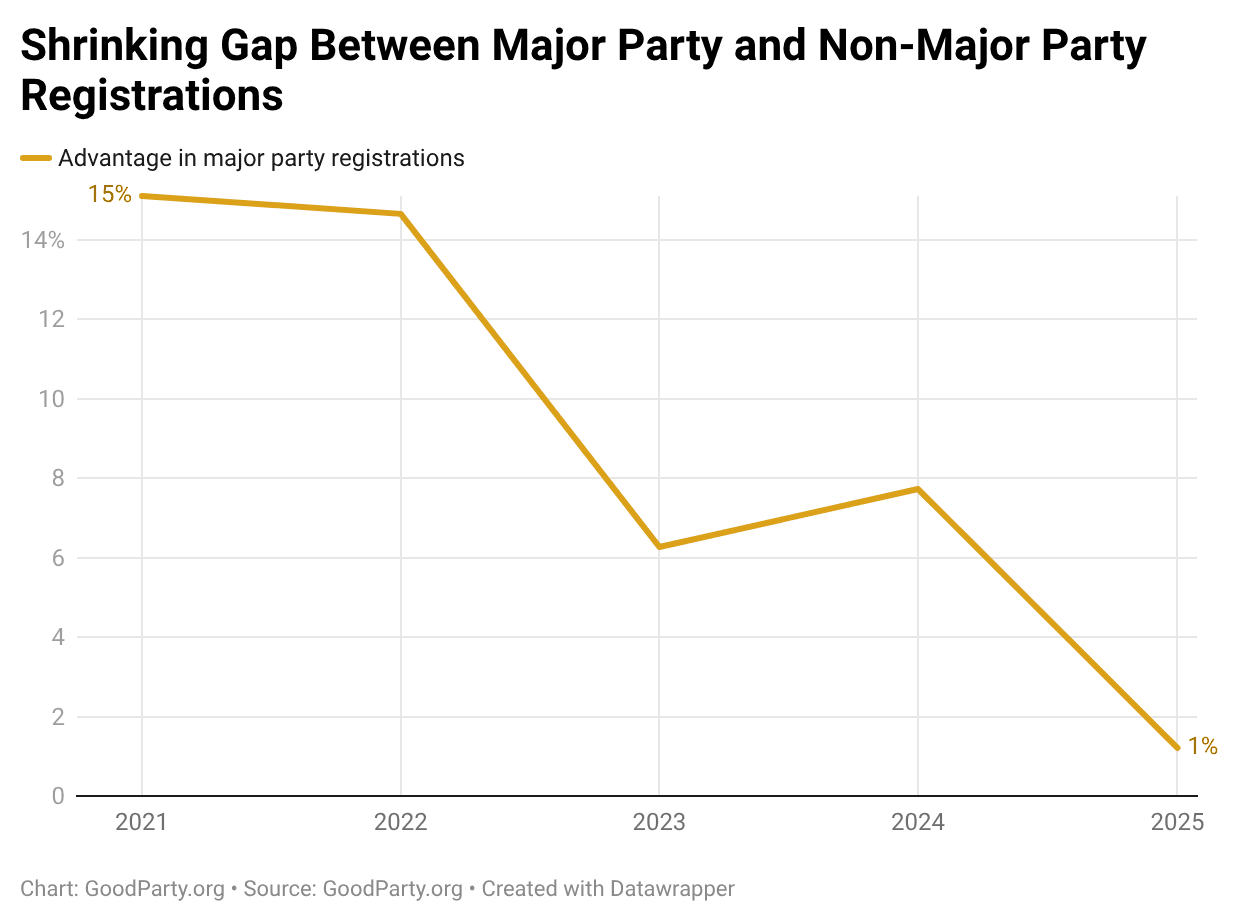
This shift demonstrates that Americans — particularly newer and younger voters — are increasingly opting not to default into traditional partisan alignment, but instead choose Independent or third-party registration from the outset.
As that trend continues, it could reshape how elections function at multiple levels. Fewer voters formally aligning with the two major parties may lead to a decline in participation in partisan primaries and increase attention on reforms such as open or nonpartisan primary systems in some states.
Additionally, this data points to a political environment that is increasingly receptive to candidates with Independent or third-party backgrounds.
In 2025, GoodParty.org empowered over 13,000 Independent candidates to run, win, and serve in local communities across the country. As the share of Independent voters continues to increase, particularly on the heels of younger voters, so too will the share of candidates and elected officials who choose not to identify with the two major parties.
Join a community of changemakers
Connect with independent problem-solvers and explore free resources for launching your campaign
#2: 2025 Saw the Lowest Number of New Major-Party Registrations in Five Cycles
New registrations with the two major parties declined sharply in 2025.
In 2023, 3,690,464 Americans registered as Democrats or Republicans. In 2025, that number dropped to 2,456,673.
By comparison, 2,397,975 voters registered as Independent or with a third party in 2025 — consistent with trends observed in previous odd-year cycles. A majority of these voters chose to register as Independent or unaffiliated, while the largest third parties included: Libertarian, Green, Working Families, and Conservative.
Despite most commentary focusing on shifts between the two major parties, our analysis suggests a broader trend: overall partisan registration is declining, not simply shifting from one major party to the other.
#3: Nearly Half of States Now See More Non-Major Party Registrations Than Major-Party Registrations
In 2025, 24 states recorded more new non-major-party registrations than new registrations with either major party.
That compares to just 14 states in 2021.
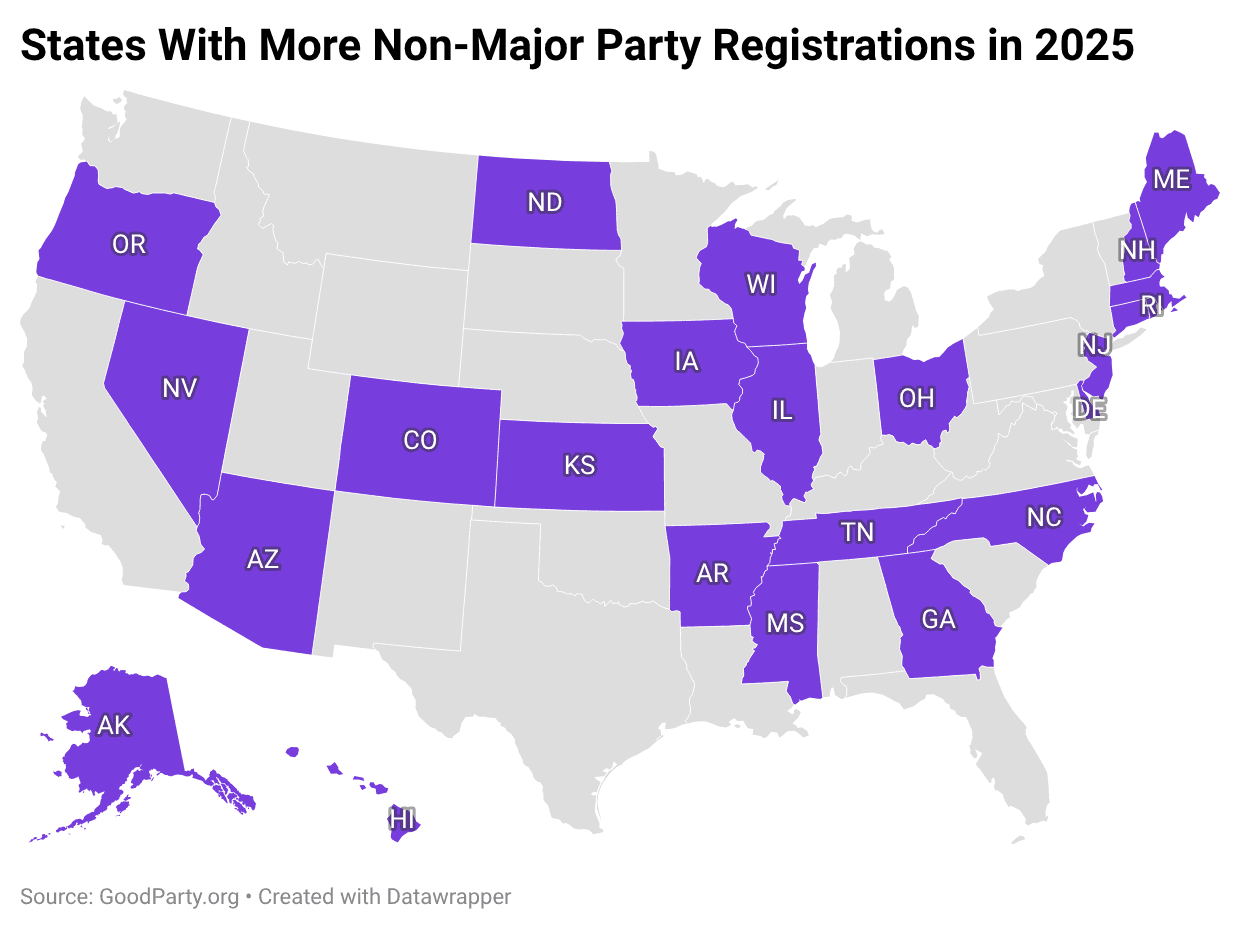
A majority of states that publicly report partisan registration numbers are seeing similar patterns: new Independent and third-party registrations are reliably exceeding major-party registrations each year.
This shift is especially notable in several battleground states, including Georgia, North Carolina, Wisconsin, Arizona, Nevada, and Maine — states that historically see significant partisan investment and mobilization.
#4: Registration Activity Is Year-Round — and Independents Follow the Same Seasonal Patterns
Monthly voter registration trends show that new Independent and major-party registrations follow nearly identical seasonal patterns.
October remains the most common month for new voter registrations, followed by September, August, and November.
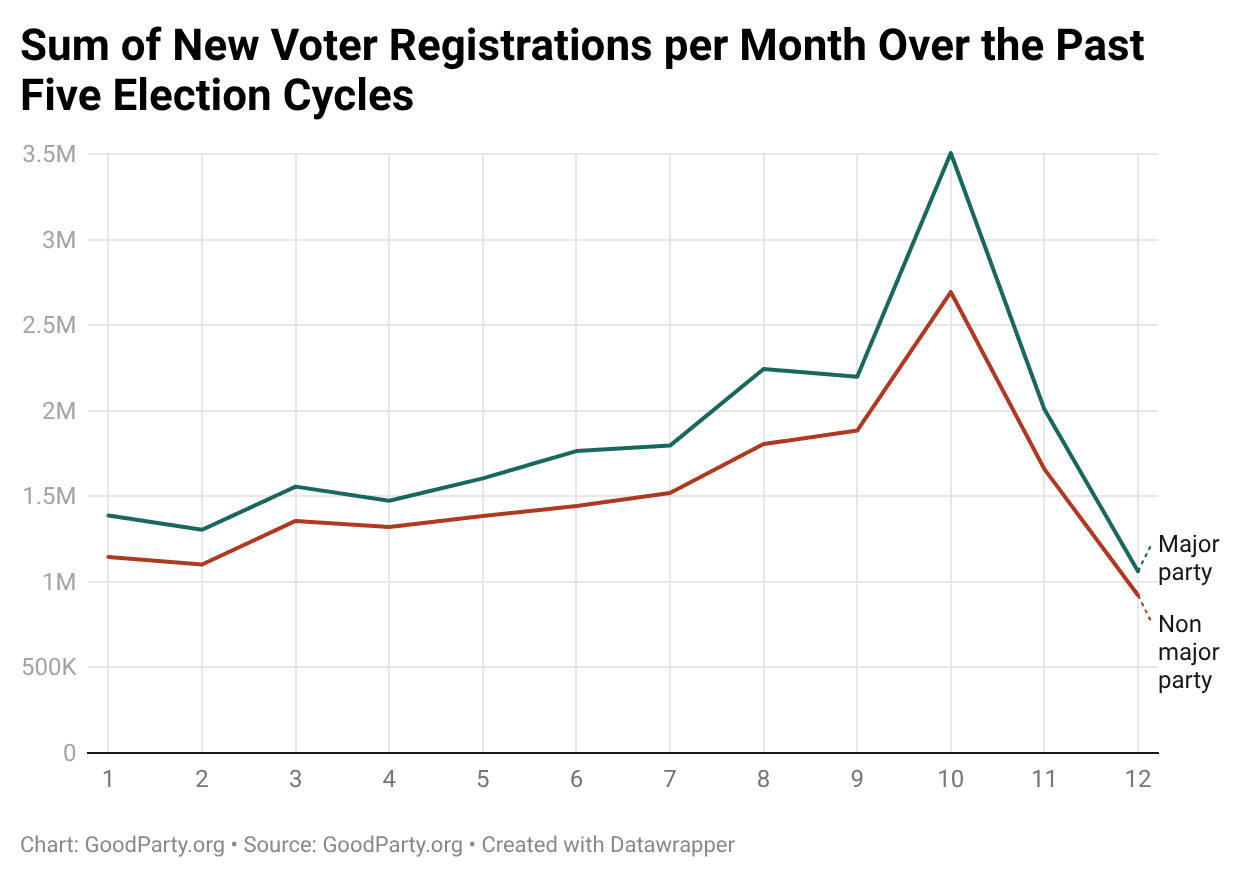
Over the past five election cycles, more than two million voters registered in nearly every month of the year (with the exception of December), underscoring that voter engagement is a year-round phenomenon — not limited to peak election season.
Meeting the Moment
According to the latest Gallup polling, 45% of Americans identified as politically Independent in 2025, marking the highest share Gallup has recorded since it began tracking party identification in 1988.
In the same poll, 27% of respondents identified as Democrats and 27% as Republicans, placing Independents well ahead of both parties as the largest political group.
This analysis reinforces that shift — not just in attitudes, but in actual voter behavior.
As newer voters increasingly choose to register as Independent or third-party voters, the political landscape is evolving ahead of the 2026 midterms and the 2028 presidential election cycle.
At GoodParty.org, we believe this moment represents an opportunity.
In 2025 alone, GoodParty.org supported more than 13,000 winning Independent candidates nationwide by providing accessible campaign tools, peer support, and free resources to identify open seats on the ballot.
If more voters are choosing political independence, we need more Independent candidates ready to serve.
Join the Independent movement and become part of our online candidate community today.
Photo by henry perks on Unsplash