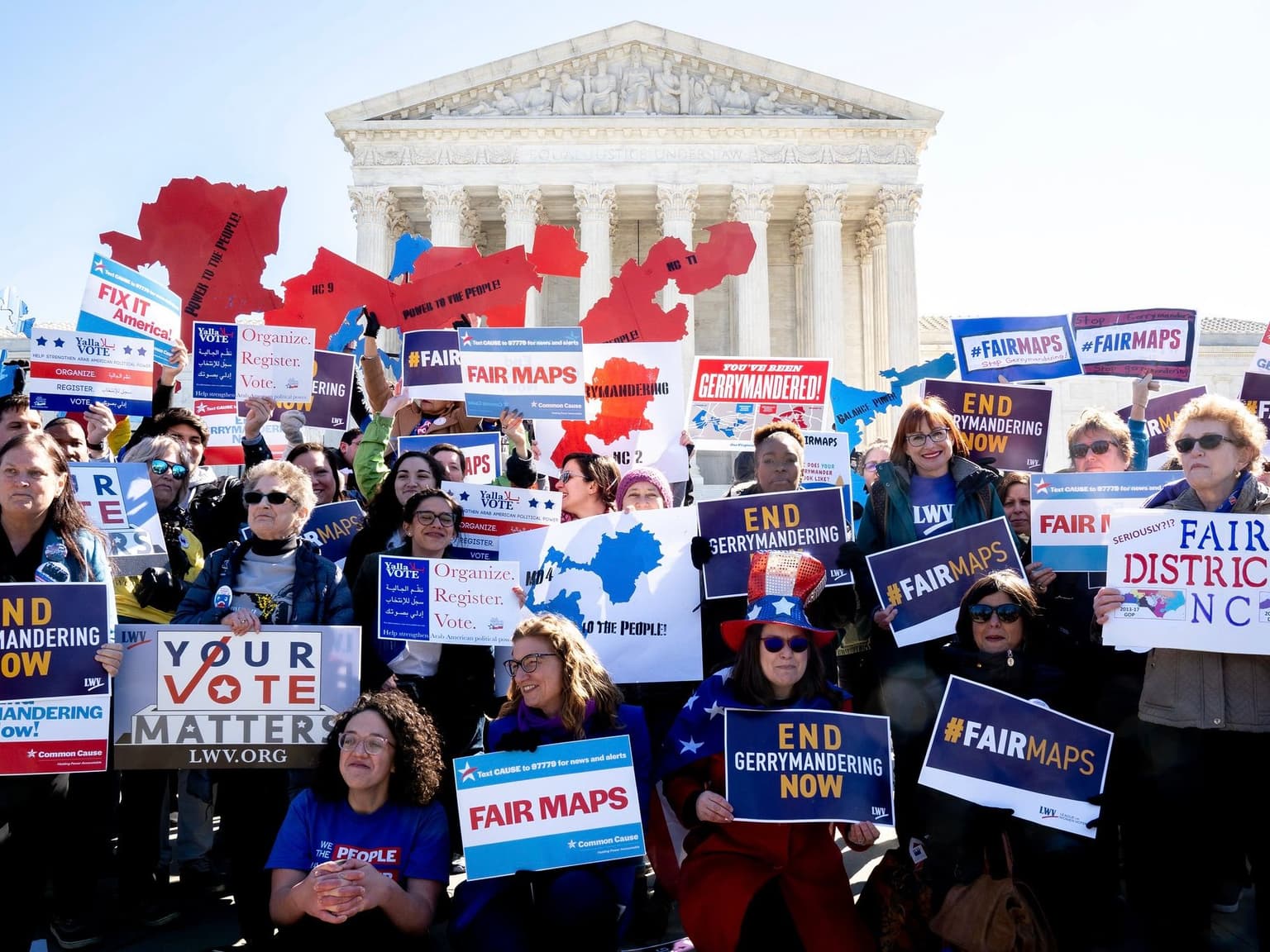
Every 10 years, after the U.S. Census, states redraw their local and congressional districts. The idea is straightforward: as populations shift and grow, district boundaries should reflect those changes to ensure fair representation.
Partisan gerrymandering interferes with that principle of fair representation.
Instead of drawing districts based on population trends and voters' interests, political parties manipulate boundaries to lock in electoral advantages. The result is a system where politicians choose their voters instead of the other way around.
Here's what partisan gerrymandering actually is, why it's a problem for democracy, and what we can do about it:
What Is Partisan Gerrymandering?
Partisan gerrymandering is the practice of drawing electoral district boundaries to give one political party a structural advantage over another.
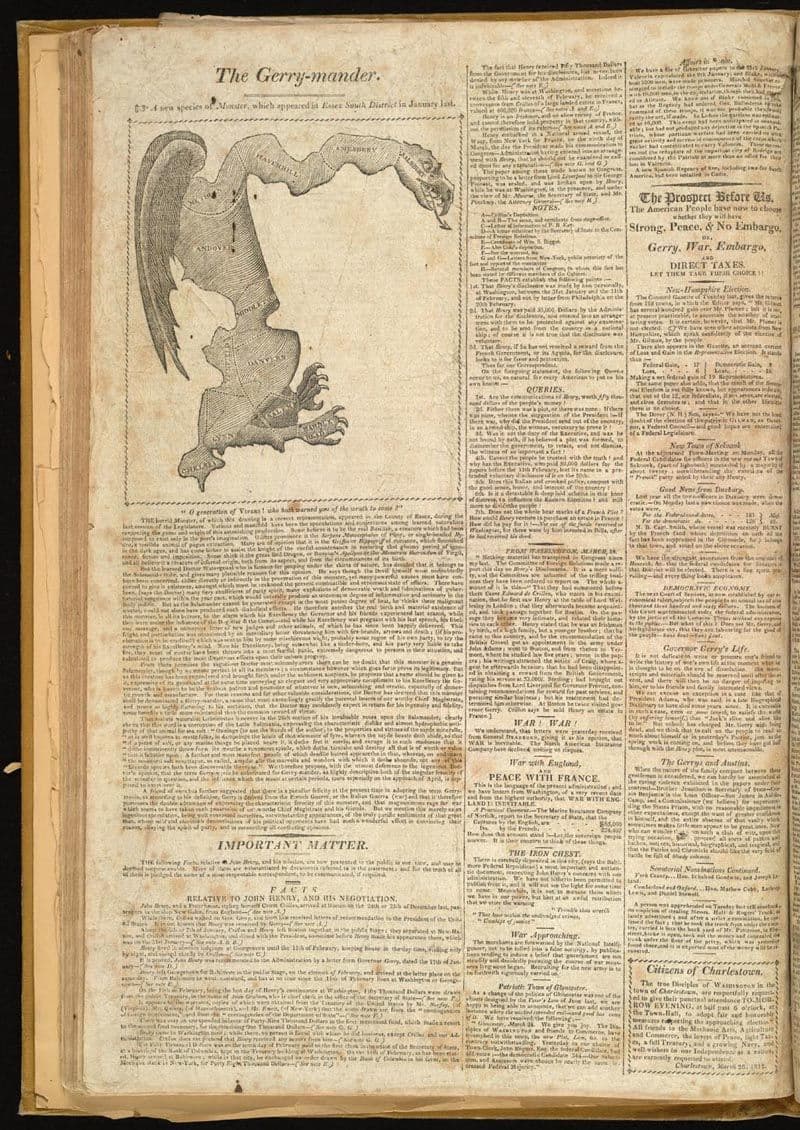
The word "gerrymandering" traces back to 1812. In that year, Massachusetts Governor Elbridge Gerry approved a strange-looking redistricting map that favored the Democratic-Republican Party.
The Boston Gazette responded by publishing a cartoon of the map, comparing the district’s shape to a salamander. The cartoon's caption read, "The horrid Monster of which this drawing is a correct representation, appeared in the County of Essex, during the last session of the Legislature."
This image of the salamander combined with Gerry’s name to give us the portmanteau gerrymander.
Since then, many more "horrid Monsters" have appeared across the United States. The result is an increase in "safe" Democratic or Republican districts, where healthy competition is replaced with an easy win for whichever political party is currently in power.
How Does Partisan Gerrymandering Work?
District lines are typically redrawn every 10 years after the U.S. Census.
In 34 states, the state legislature controls its own district lines, and 39 states give legislatures control over congressional districts as well. Only a handful of states use independent commissions to limit partisan influence over the process.
Here's where gerrymandering comes in:
Imagine a state where Democratic voters make up 60% of the electorate and Republican voters make up 40%. In a fair system, you'd expect Democrats to win most of the seats.
With gerrymandering, mapmakers can "pack" the majority of blue voters into just two overwhelmingly blue districts, and "crack" the remaining blue voters across three other districts. This dilutes their influence enough that Republicans win each of those three seats. The result: Republicans control the majority of seats despite winning fewer votes overall.
It's the equivalent of winning 40 votes in a student council election and being declared the winner over someone who received 60 votes.
Gerrymandering produces a system where elections are effectively decided before a single vote is cast. This ensures that the party in power can entrench itself indefinitely, regardless of how voters feel about it.
Thinking about running for office?
Learn how with our free guide to serving your community.
Historic and Current Examples of Partisan Gerrymandering
Partisan gerrymandering isn't theoretical. From the 1800s to the present, gerrymandered districts have shown up across many states' voting maps:
Famous Examples of Gerrymandered Districts
Some examples of gerrymandering stand out more than others. Some are even famous enough to have nicknames for their oddly-shaped districts.
Here are a few of the most notable:

North Carolina's 12th Congressional District
Created in 1992, North Carolina's 12th Congressional District was drawn as a narrow corridor that stretched more than 160 miles. This corridor connected predominantly Black communities and concentrated their voting power in the district, creating a majority-minority district.
The 1992 map was eventually ruled unconstitutional, and North Carolina's maps have been redrawn multiple times since. A look at the evolution of North Carolina's voting map from 1992 to 2017 shows the gradual redrawing of the once-serpentine district.
Maryland's 3rd Congressional District
Redrawn by Democrats in 2011, this district became so contorted that a federal judge famously described it as resembling a "broken-winged pterodactyl, lying prostrate across the center of the state." One sliver in northeast Baltimore is narrower than two city blocks. The boundaries were designed to consolidate Democratic voters across disconnected geographic pockets spanning Baltimore, Howard, Anne Arundel, and Montgomery counties.
Ohio's 4th Congressional District
This district was redrawn by the Republican-controlled Ohio legislature in 2011. It became so notoriously misshapen that locals gave it a nickname: "the duck," or sometimes, "the drunken duck."
The district zigzagged west and south from Cleveland's suburbs. A federal panel ruled the map unconstitutional in 2019, but the Supreme Court's ruling in Rucho v. Common Cause foreclosed federal remedies for partisan gerrymandering, and the district's shape held until new maps were drawn in 2022.
In 2018, a local news source described the gerrymandered district as placing "Ohio's most liberal city," Oberlin, under the leadership of "its most conservative Congressman." This is a prime example of how gerrymandering can frustrate voters: diluting the voting power of some while concentrating that of others.
A New Wave of Partisan Redistricting
The 2025-2026 election cycle has brought about one of the most significant mid-decade redistricting pushes in modern American history.
States historically redistrict once per decade, following the U.S. Census. Starting in 2025, however, multiple states have begun redrawing congressional maps between census cycles. Their goal: give their party an advantage ahead of the 2026 midterm elections.
As of May 21, 2026, nine states had approved new maps. Here is a timeline of their approval:
- Texas: The Republican governor signed a new map into law on Aug. 29, 2025. Since then, the U.S. Supreme Court has ruled that the new map can be used.
- Missouri: The Republican governor signed a new map into law on Sept. 28, 2025.
- Utah: On Nov. 10, 2025, a district court ordered that a new map be used in the 2026 elections. This map shifted one district toward Democrats.
- North Carolina: The legislature approved a new map on Oct. 22, 2025, favoring Republicans.
- Ohio: A redistricting commission approved a map favoring Republicans on Oct. 31, 2025.
- California: Voters approved a new voting map on Nov. 4, 2025, giving Democrats a greater advantage.
- Florida: The Republican governor signed a new map into law on May 4, 2026.
- Tennessee: The Republican governor signed a map into law on May 7, 2026.
- Alabama: On May 11, 2026, the U.S. Supreme Court lifted previous injunctions against a new map favoring Republicans.
This redestricting battle is ongoing, and other states are in the process of considering new maps. So far, both major parties have pursued redistricting where they already held power. However, the structural imbalance is real: Republicans control more state legislatures than Democrats in 2026, giving them more opportunities to act.
The legal landscape also shifted significantly in April 2026, when the Supreme Court issued its ruling in Louisiana v. Callais. The decision weakened Section 2 of the Voting Rights Act, which had previously been used to challenge maps that had the effect of diluting minority voting power. Under the new standard, plaintiffs must demonstrate intentional discrimination, a significantly higher bar.
As NPR reported in May 2026, the redistricting fight has become one of the key variables shaping which party controls Congress after November 2026.
Why Is Partisan Gerrymandering a Problem for Democracy?
Partisan gerrymandering gives one political party a structural advantage over another, but that’s not its only effect. There are more harmful impacts for voters:
Disenfranchising Voters
When district boundaries are drawn to guarantee one party's victory, the outcome of an election is effectively predetermined.
That sense of futility discourages voter turnout and civic engagement. This is particularly true in communities that repeatedly find themselves on the losing end of a rigged map.
Feeding Political Polarization
Gerrymandered districts create "safe seats" where candidates don't need to appeal to voters in the political center. They just need to win a primary.
This is most obvious in districts where only one major political party is on the ballot. In the 2022 general election, 35 congressional districts had only one major party represented on the ballot.
For example, Texas’s 6th, 11th, 19th, 25th, 26th, and 31st U.S. House districts each had one Republican candidate on the general election ballot, with no Democratic opposition. Unless an independent or third-party candidate also competed in the general election, these Republican candidates won their districts with 100% of the vote.
Diluting Minority Representation
Gerrymandering has historically been used to dilute the voting power of minority communities. The common methods are known as “packing” and “cracking.” Gerrymandered maps “pack” minority communities into a single district, or “crack” neighborhoods into multiple districts.
When minority populations are fragmented, their collective influence in any single election shrinks, and so does their representation in government.
Increasing Barriers for Independent Candidates
Partisan redistricting creates an additional structural barrier for anyone running outside the two-party system.
There are already numerous barriers to entry for independent candidates at the federal level. When maps are drawn to protect incumbents and entrench party power, independent and unaffiliated candidates face an even steeper climb.
Reducing Political Accountability
Safe seats leave less incentive for accountability. When elected officials feel assured that they can easily win reelection, they are less motivated to act in ways that benefit their entire constituencies. This dynamic is one reason political dysfunction persists at every level of government.
LEARN MORE: Learn more about why fair representation matters in a nation as diverse as the United States.
How Can We Stop Partisan Gerrymandering?
Stopping partisan gerrymandering requires sustained pressure from multiple directions. Here are some of the most effective approaches:
Strategy #1: Push for Independent Redistricting Commissions
Independent redistricting commissions have less bias than partisan governors or state legislators. States that rely on independent, nonpartisan commissions to draw district maps consistently produce fairer, more competitive elections.
If you live in a state that allows citizen-led ballot initiatives, supporting or introducing ballot propositions for independent commissions is one of the most direct actions available.
Strategy #2: Attend Public Hearings
Redistricting processes include public comment periods. Many legislators never hear meaningful opposition. Showing up to those hearings, speaking on the record, and making clear that voters are paying attention gives reformers a seat at the table and creates a documented public record.
Strategy #3: Organize Around Communities of Interest
Many states include provisions in their redistricting rules requiring mapmakers to keep communities of interest (groups that share social, economic, cultural, or geographic characteristics) together in a single district.
Publicly making the case for why your community should remain intact during the next redistricting cycle can directly influence how maps are drawn.
Strategy #4: Support Electoral Reform
Reforms like ranked choice voting and open primaries reduce the structural advantages that make partisan gerrymandering so powerful. When candidates must appeal to voters beyond their party's base to win, the incentive to carve out safe seats diminishes.
Strategy #5: Engage the Courts
State courts are an important avenue for challenging gerrymandered maps. Pennsylvania's Supreme Court struck down the state's congressional map in 2018. North Carolina's Supreme Court did the same in 2022, though that ruling was later reversed in 2023.
Monitoring and supporting redistricting litigation through nonprofit legal organizations remains one of the most effective long-term strategies.
Running for Office in a Gerrymandered District
Challenging an incumbent in a gerrymandered district is difficult, but it's not impossible. It’s also a great way to advocate for your community. By putting your name on the ballot, you’re giving your neighbors another option and a real choice on election day.
You can use your campaign as a platform to speak out against gerrymandering. Kate Barr did exactly this in her 2024 campaign for state senate in North Carolina’s 37th district. As Barr told Democracy Docket in an interview:
“I’m running because I fundamentally believe voters deserve a choice. And even when the deck is stacked so heavily in favor of one candidate — as it is in our gerrymandered district and across our gerrymandered state — we still benefit from having two names on the ballot.”
Here are a few tips for running in a gerrymandered district:
- Represent Your Community, Not a Party: Running as an independent or unaffiliated candidate shows voters that you’re there to represent them, not partisan interests.
- Be Transparent About Gerrymandering’s Impact: Voters in gerrymandered districts often already know something is wrong. They just can't always name it. Being candid about how partisan gerrymandering has distorted their representation can be a powerful part of your campaign message.
- Know Your District: Understand the demographics, the local issues, and what residents care about. The more you can speak to your community's real concerns, the more effectively you can cut through the partisan noise.
- Build a Grassroots Base: Prioritize door-to-door canvassing, community events, and direct voter contact to compete effectively. Grassroots campaigns are how underdog candidates level the playing field.
- Take Advantage of Coalition Building: You're likely not the only candidate in your area who’s frustrated by rigged maps. Connecting with like-minded candidates across party lines and sharing resources can amplify your reach in ways that a solo campaign cannot.
LEARN MORE: Read our complete guide to running for office as an independent candidate in 2026.
Taking on the System
Partisan gerrymandering is one of the most visible ways the two-party system maintains its grip on political power. It lets politicians choose their voters, reduces accountability, and adds extra barriers to fair representation.
Independent redistricting commissions, legal challenges, electoral reform, and the growing movement of independent candidates are all chipping away at the conditions that make gerrymandering possible. Change takes time, but it starts with voters and candidates who refuse to accept a rigged map as a fixed reality.
If you're ready to take on the system, GoodParty.org offers free tools and resources built specifically for independent candidates. Start exploring how you can stand up for your community today.
Feature photo by Victoria Pickering via Creative Commons. Map of North Carolina Congressional districts from Wikimedia Commons.